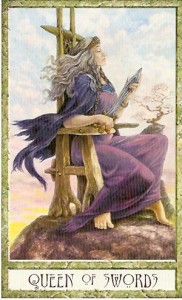
 Of all of the tarot cards, it’s the court cards which tend to cause most confusion for beginner tarot readers. It’s all very well learning that the Queen of Swords represents an aloof, manipulative, dark-haired woman, but what if you (or your querent) don’t know anyone who fits that description, and what if it’s completely irrelevant to the question in hand?
Well, although the court cards in tarot often represent an individual person, that’s not always the case. Sometimes, the court cards represent aspects of the person having the reading. At other times, they represent specific situations. At yet other times, they may represent a stage of knowledge or learning. It’s up to you as a tarot reader to get to know the court cards, so that you can recognize which of their many guises is applicable to each reading.
Start with the Court Card Suits
The first thing to understand is that the Page, Knight, Queen and King of each suit are embodiments of that suit’s element. The Wands are associated with fire, so these are all-action, creative, impulsive, feisty cards. The Cups are associated with water, so here you’re looking at gentle, spiritual, emotional and sensitive cards. The Swords are associated with air, so these cards are intelligent and analytical, but emotionally distant. The Pentacles are associated with the earth element, so it’s common sense, practicality and steadfastness for these court cards.
The Royal Hierarchy
Pages represent children, if they represent people. As events, pages are messengers and they often turn up when something new is happening - a new event, a new job, a new birth, a new project.
Knights represent older teenagers and young men and women, as people. As events, however, the knights bring a great deal of change. Always charging here, there and everywhere, knights represent challenges and adventures.
Queens typically represent adult women as people, but as events, the queens tend to represent creativity and nurturing happenings.
Kings, as you might expect, are adult males when representing people, but as events, the kings tend to turn up when a project is nearing completion, or when an idea is about to become a reality.
Getting Personal
A good way to get to know the court cards better is to work with them in your tarot journal. Take each card in turn, and note down what you know about the card’s physical representations - eg traditional hair color, age and so on. Do you know anyone that meets this description? Is so, write down their name. Now think about this court card’s perceived personality. Can you match that with anyone? Write down their name too. Do this for each card. Don’t worry if you can’t attach names to each one - maybe you can think of a fictional character who matches this description?
Next time you draw a court card in a spread, remember the real (or fictional) person you linked it to. Think about what that person would say and the advice her or she would provide in that position in that spread. For instance, if the King of Wands turns up in the “near future” position in a spread, and he reminds you of your father, ask yourself what your father would counsel the querent to do as an immediate reaction to his or her situation.
By creating links between the court cards and real people, they cards will start to come more alive in your mind, making it that much easier to read them both for yourself and for others.

